

Government
Lashley: Police Must Embrace Technology To Fight Crime
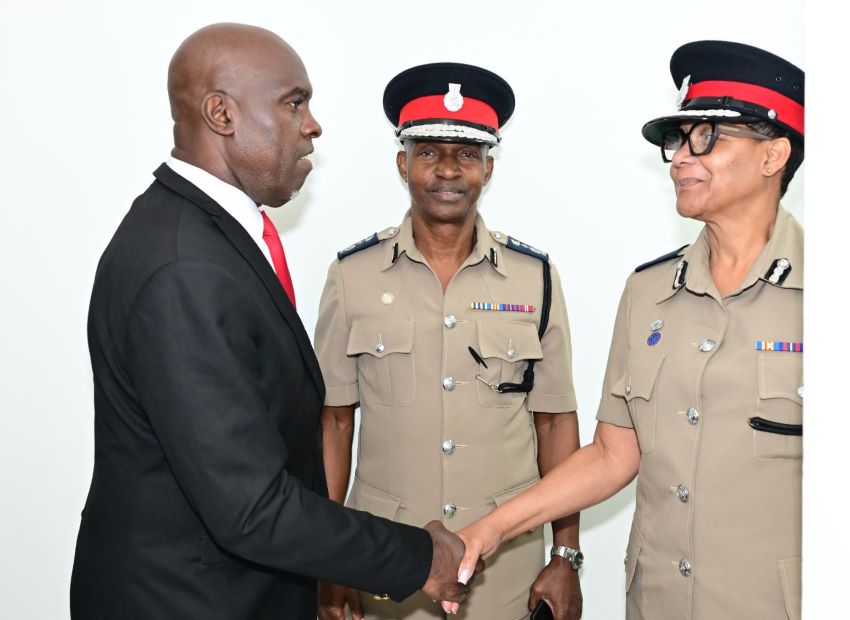
The modernisation of The Barbados Police Service (TBPS) is no longer optional but essential, says Minister of Legal Affairs and Criminal Justice, Michael Lashley.
Speaking at the opening of TBPS’ Annual Grand Conference at the Lloyd Erskine Sandiford Centre (LESC) on Tuesday, Mr. Lashley reinforced that policing was now more complex than any time in history, noting that the public’s expectation of justice and accountability was “higher than ever”.
The two-day conference is being held under the theme: Advancing Modern Policing Through Commitment to Professionalism, Technological Solutions and Community Engagement.
Stating that crime has evolved, with technology enhancing both opportunity and threat, Mr. Lashley outlined some critical priorities to guide the advancement of local policing.
“And, it must start first with legislative enforcement and the notion and concept of speedy justice. Effective policing depends not only on strong laws, but on timely enforcement of those laws to the law courts. One of the most significant contributors to delay in the justice system is the late preparation and submission of case files. The timely preparation, completion and presentation of files to the office of the [Director of Public Prosecutions] and the courts are, therefore, essential to achieving speedy trials and maintaining public confidence in justice,” he stated.
The Legal Affairs and Criminal Justice Minister also noted that with Barbados working to establish a gun court, files must be readily available for it to start functioning and making an impact on the criminal justice system. He further noted that delayed justice weakened cases, undermined deterence and burdened victims, since they looked forward to having their day in court.
“Case studies show that speedy justice results in a reduction in crime, and so I am attracted to this notion that modern policing will involve the timely preparation of case files,” he said.
He also stressed the importance of adopting international best practices, leveraging technology, and enhancing working conditions for police officers, adding that community engagement and collaboration with judicial and prosecution services were also crucial for effective policing and public trust.
“Modern policing must also be forward looking and globally informed. TBPS exists in a world where criminal networks cross borders and policing innovations are constantly evolving. No police service can operate in isolation.
“There is, therefore, a need for the force to borrow, adapt and implement best practices from leading police forces internationally in terms of case management systems, leadership development, forensic capability, intelligence-led policing and community safety strategies,” the Minister stated.
He continued: “The use of technology is at the core of policing. …If we are seeking to bring back public confidence and strengthen public safety, we have to endorse all modern technologies available,” Mr. Lashley emphasised.
He also advised that transparency and accountability would guide community engagement by police officers.
“We need public cooperation for crime detection and prevention. We must engage strongly with communities. It builds confidence, it gives the police officers and persons living in communities some comfort. And so once that is fully engaged, there will be awareness of the citizen to cooperate with the police.
“And so…community engagement must go hand-in-hand with collaboration with the judiciary, prosecution services and other stakeholders within the criminal justice system. The police officer must, therefore, remain both guardian of the law and partner of the community,” the minister maintained.
In terms of the establishment of a gun court, he offered some advice to help enhance local policing: the proper up keep of records; ballistic experts; the need for a chief investigator; and a statement from the accused.
“The message I’m sending is that even if TBPS is saying ‘we are overburdened and we have a backlog in terms of ballistic experts’, I believe that we can draw from other jurisdictions. And of course, Barbadians overseas will be willing to come and assist so we can exhibit justice in these matters.
“I would like to believe that when the gun court is established that it will be ready to roll with those cases, particularly firearm-related cases and the simple possession of firearms because you have to send a message and a signal,” Mr. Lashley emphasised.
The conference concluded yesterday at LESC. (PR/GIS)
Caption: New Minister of Legal Affairs and Criminal Justice, Michael Lashley greets Deputy Commissioner of Police, Sonia Boyce while Commissioner of Police, Richard Boyce, looks on