



International
Twin Earthquakes Devastate Venezuela as the Caribbean Rallies in Solidarity
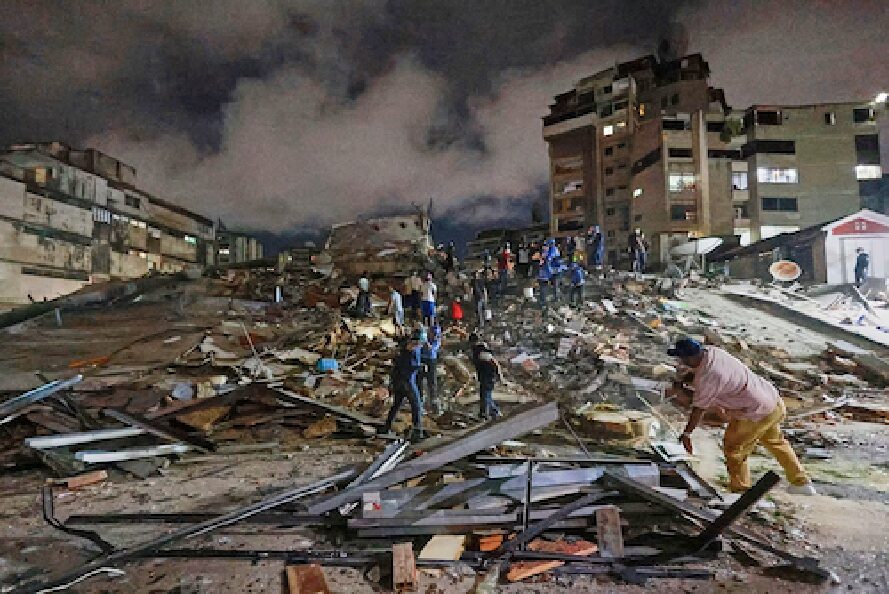
Hundreds dead and nearly a thousand injured after the strongest quakes to strike the country in over a century; relief teams from across the Americas mobilise as the region’s families brace for a rising toll.
CARACAS — Two powerful earthquakes struck northern Venezuela on the evening of Wednesday, 24 June, collapsing buildings across the capital and leaving a nation in mourning. As of Thursday morning, authorities confirmed at least 164 people dead and 971 injured — figures officials and international agencies warn are almost certain to climb as rescue teams reach the worst-affected areas.
The first tremor, a magnitude 7.2, struck near the town of San Felipe, roughly 100 miles west of Caracas. A larger magnitude 7.5 quake followed just 39 seconds later, near the town of Yumare. The back-to-back shocks were among the strongest to hit Venezuela in more than a hundred years, and were felt across the country and into neighbouring Colombia. More than thirty aftershocks rattled the region in the hours that followed.
The disaster struck on a national holiday marking the 205th anniversary of the 1821 Battle of Carabobo, the engagement that secured Venezuela’s independence. With most Venezuelans off work and gathered at home, the timing turned residential buildings into the centre of the catastrophe. Footage circulating on social media captured the moment a building collapsed in El Junquito, while emergency workers were filmed climbing through the ruins of fallen structures in the capital as night fell.
A capital in crisis
Acting President Delcy Rodríguez declared a state of emergency, closing the airport in Caracas, suspending rail service and cancelling school for several days. The state of La Guaira, north of the capital, was described by Rodríguez as a “true tragedy” and a “disaster zone” — and crucially, casualty figures from that hard-hit region had not yet been folded into the national count, underscoring why officials expect the toll to rise.
The United States Geological Survey issued a red alert for the disaster, cautioning that high casualties and extensive damage were probable and that the event was likely widespread. Survivors described scenes of terror. One resident who escaped a damaged building likened the experience to a horror film; another, who had lived through the 1967 Caracas quake, said the disaster was unlike anything he had known.
A region responds
For the Caribbean and the wider Americas, the response has been swift — and pointedly regional. The Dominican Republic dispatched rescue teams, while Brazil and China sent humanitarian aid and Qatar prepared a rescue brigade. The Pan American Health Organization, the WHO’s regional arm, coordinated with relief organisations mobilising medical supplies for the trauma and crush injuries that follow major seismic events. World Central Kitchen, the food-relief group founded by chef José Andrés, pledged an immediate one million US dollars toward relief.
Venezuela sits in a seismically active zone where the Caribbean Plate grinds against the South American Plate — the same restless geology that shapes risk across much of our region. It is a sobering reminder that the Caribbean’s shared exposure to natural disaster is matched only by its shared instinct for solidarity. Messages of sympathy arrived from across the hemisphere and beyond, with the United States pledging search-and-rescue teams, medical resources and humanitarian assistance, and European leaders voicing solidarity with the Venezuelan people.
Among the voices of condolence from the multilateral community was the Permanent Mission of the Commonwealth of The Bahamas to the United Nations, whose Permanent Representative, H.E. Ambassador Stan O. Smith, conveyed the sorrow and solidarity of the Bahamian people to Venezuela’s mission in New York, describing the region as bound “not only by geography and shared history, but by a common understanding of how swiftly nature can test the resilience of our peoples.”
What comes next
Rescue and recovery operations continue around the clock, complicated by damaged infrastructure and intermittent communications, which fell sharply in the immediate aftermath before partially recovering. With many still feared trapped beneath collapsed buildings, the coming days will test both Venezuela’s emergency response and the depth of regional cooperation. For a hemisphere that knows the cost of hurricanes, floods and earthquakes all too well, the measure of this moment will be how quickly help reaches those who need it — and how long the solidarity endures once the headlines fade.