

Local
Creating An Ocean-Conscious Barbados

Summer in Barbados has become synonymous with learning to swim in the ocean, for free, compliments of the National Conservation Commission’s (NCC) Operation Save Our Selves (S.O.S.). Each year, for a duration of seven weeks, participants in the programme are taught water safety and marine environmental awareness.
Swimmers in the making, ranging to date from aged 10 to 81, are immersed in the experience of ocean swimming, while being introduced to the hazards and responsibilities of the marine environment. Through daily physical engagement and guided discussions, participants gain a deeper appreciation for the waters surrounding Barbados.
This summer, the NCC received an overwhelming response to the highly anticipated public education initiative, with 105 persons signing up. Instruction is underway and takes place at Brownes Beach, Bay Street, St. Michael, under the watchful eye of the Barbados Lifeguard Service.
Acting Deputy General Manager of the NCC, Ricardo Marshall, gave the Barbados Government Information Service (BGIS) the historical background of the programme. “Operation S.O.S. was designed and launched in 2009, with the primary goal of equipping citizens with critical lifesaving swimming skills, and encouraging a deeper understanding of and respect for the marine environment.
“Living on an island of approximately 166 square miles, knowledge of the aquatic environment is not just useful, it’s essential. Despite this, a surprising number of Barbadians are still unable to swim. Recognising this concern, Operation S.O.S. continues to empower citizens with lifesaving aquatic skills and knowledge,” he outlined.
The NCC’s Deputy General Manager continued: “Swimming is more than fitness; it’s survival. The ability to swim is a fundamental life skill that builds confidence, promotes physical health, and, more importantly, serves as a vital preventative measure against accidental drowning. Being able to swim can help save not just your own life, but possibly someone else’s,” Mr. Marshall emphasised.
The programme’s modules include Drowning Prevention Education; Water Safety Do’s and Don’ts, Understanding Currents, Tides and Beach Signage; Recognising Flags, Wind, Waves (Sets & Lulls), and Special Focus: Hands-Only CPR.
Head Lifeguard Instructor, Dave Bascombe, has been with the programme from the time of its inception, 16 years ago. “Our rescue forms show the demographic of those folks – especially children transferring from primary to secondary school – who get into difficulty. And so, we had to do something to avoid us, as lifeguards, having to continually rescue persons.
“If you can save yourself, it means that your chances of getting into difficulty are lessened. Some of the children also go on to join swim clubs and play water polo. The elderly, who weren’t confident around water, grow in confidence. The programme is free but it is priceless,” he said proudly.
Upon completion, participants are expected to acquire basic swimming skills to save themselves, recognise and understand common aquatic threats, and develop respect for the marine environment, through practical exposure and educational engagement.
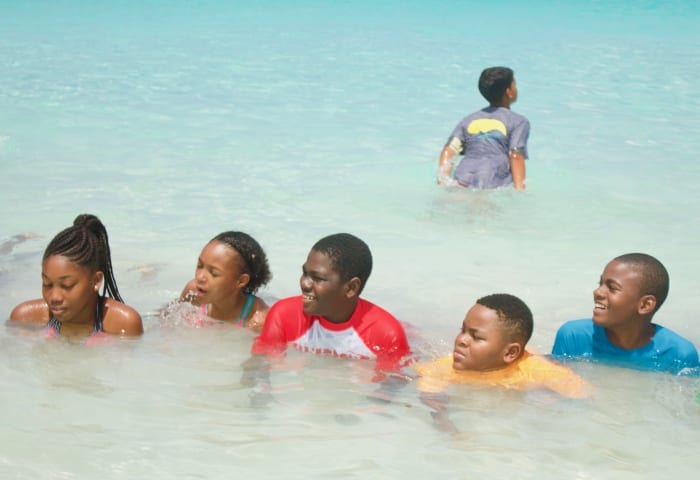
The programme is conducted from July to August. Participants attend weekly one-hour sessions, in the mornings or afternoons, on Mondays, Wednesdays and Fridays, from 9:30 a.m. to 10:30 a.m., and 11:00 a.m. to 12:00 p.m. At the end of the programme, participants each receive a certificate in recognition of their achievements.
One such participant was Andrea Rolston, who learned to swim in 2022. “We had a competition on the last day of the programme, and it was really good. It was so much fun and I was proud to receive my certificate,” she said beamingly.
Andrea, who is in her early 60’s, had nothing but good things to say about her experience in the programme. “It was wonderful. The instructor was great and he was really pleasant. I would say that it was very easy to learn to swim in the programme. We started to learn about the tides before we even got into the sea. We learnt safety precautions and that if we ever get into difficulty, don’t panic, just thread that water with our hands.
When asked if she would recommend the programme, Andrea had this to say: “We are surrounded by the sea and while we don’t have to be Olympic swimmers, we should always learn to swim. We had people in the class who were in their 80’s. That is what you call active ageing. It’s a great experience. I would recommend it to everyone,” she declared.
Operation S.O.S. remains a vital component of the National Conservation Commission’s commitment to public safety and environmental stewardship, as it seeks to build a safer and more responsible generation of beach users, swimmers and sea-goers.
As a flagship public education and outreach initiative of the NCC, the programme plays an essential role in creating a safer, more ocean-conscious Barbados.